
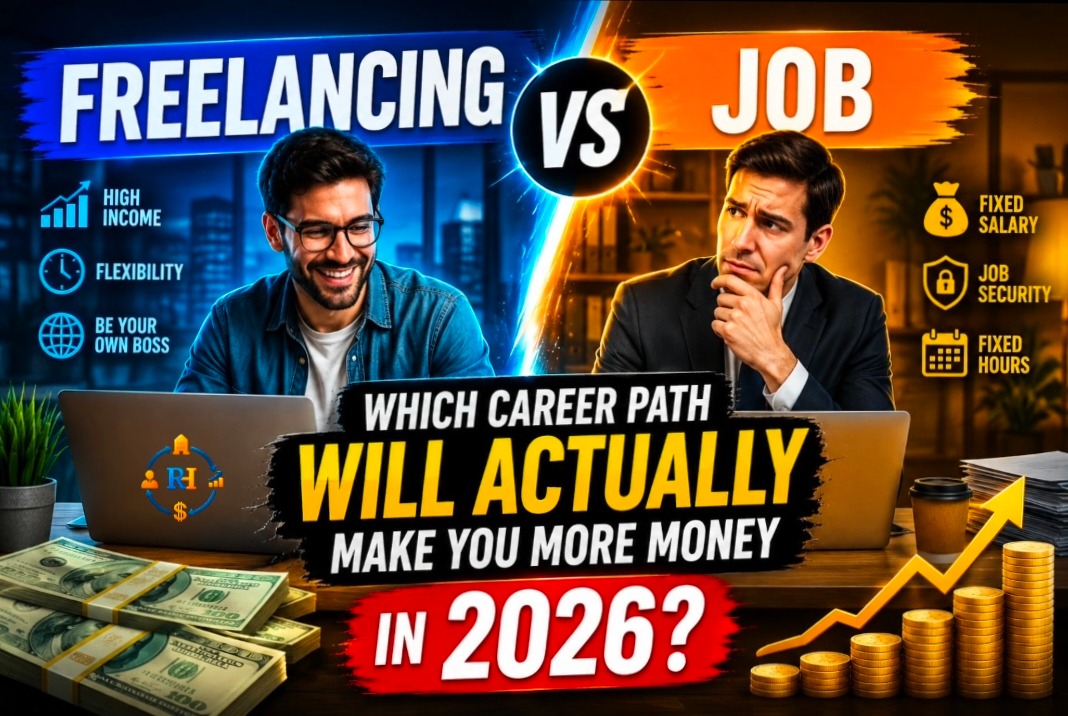
Choosing between freelancing and a job isn’t just a career decision anymore—it’s a lifestyle decision.
In 2026, where AI, remote work, and digital businesses are exploding, the traditional “safe job vs risky freelancing” debate is outdated. Both paths can make you rich—or keep you stuck.
The real question is: which one aligns with how you want to live and earn?
Let’s break it down in a way that actually helps you decide.
What is Freelancing (and Why It’s Growing Fast)?
Freelancing means you work independently with multiple clients instead of being tied to one employer.
You get paid for:
- Projects
- Hourly work
- Monthly retainers
Today, freelancing is booming in areas like:
- Performance marketing & ads
- SEO and content
- Web development
- Social media & branding
- AI automation services
Why it’s exploding: businesses now prefer lean, outsourced talent instead of full-time employees.
What is a Job (and Why It Still Matters)?
A job is a structured role where you work for one company and get:
- Fixed monthly salary
- Defined responsibilities
- Benefits (insurance, paid leave, bonuses)
Jobs still dominate because they offer predictability and security, especially early in your career.
Freelancing vs Job: The Real Differences That Matter
1. Income: Fixed vs Unlimited
A job gives you a predictable paycheck.
Freelancing gives you uncapped income.
For example:
- Job: ₹50K–₹1L/month fixed
- Freelancing: ₹50K → ₹5L+/month depending on clients and skill
But here’s the truth:
Freelancing starts slow, then scales fast. Jobs start stable, then grow slowly.
2. Freedom vs Structure
Freelancing:
- Work from anywhere
- Choose your clients
- Set your own schedule
Job:
- Fixed working hours
- Reporting to managers
- Limited control
If you value independence, freelancing wins.
If you value routine, a job fits better.
3. Risk vs Security
Jobs offer:
- Stable income
- Lower financial stress
Freelancing comes with:
- Income fluctuations
- Client dependency
- Need for constant outreach
But once you build systems (retainers, inbound leads), freelancing becomes far more stable than most jobs.
4. Growth Speed
In a job:
- Promotions take time
- Salary increases are controlled
In freelancing:
- You can scale anytime
- Income grows with skills + positioning
Example:
A performance marketer can go from 2 clients to 10 clients or build an agency within months.
5. Skill Evolution
Freelancers learn:
- Faster execution
- Sales and client handling
- Multi-industry exposure
Job holders learn:
- Structured processes
- Deep specialization
Freelancing builds money-making skills, not just job skills.
Pros and Cons of Freelancing
Pros
- Unlimited earning potential
- Full flexibility
- Global client access
- Opportunity to build a personal brand or agency
Cons
- No guaranteed income initially
- No employee benefits
- Requires discipline and consistency
- You must handle sales + delivery
Pros and Cons of a Job
Pros
- Stable salary
- Lower risk
- Benefits and perks
- Clear career path
Cons
- Income ceiling
- Less freedom
- Dependency on employer
- Slower growth
So, Which One is Better in 2026?
Here’s the honest answer:
Freelancing is better if:
- You want high income and independence
- You have (or can learn) high-value skills
- You’re okay with uncertainty initially
A job is better if:
- You want stability
- You’re just starting out
- You prefer structured growth
The Smartest Strategy: Don’t Choose One
The biggest mistake is thinking you have to pick one.
The smartest people in 2026 are doing this:
- Start with a job (income stability)
- Build freelancing on the side
- Get 2–3 consistent clients
- Replace your salary
- Scale into an agency or personal brand
This way, you remove risk and unlock upside.
How to Start Freelancing (Action Plan)
If you want to transition:
- Pick a high-income skill (ads, SEO, AI, content)
- Build 2–3 strong case studies
- Start outreach (LinkedIn, email, WhatsApp)
- Close your first clients
- Systemize delivery + lead generation
Final Thought
A job gives you security.
Freelancing gives you leverage.
But the real power comes when you use both strategically.
In today’s digital economy, the goal isn’t just to work—it’s to build income streams that scale.